Autumn classes, 2010
Thursday, August 12, 2010
There is a new schedule at the MG for September and October!
These are the classes that I will be teaching there:
* Beginner Silversmithing course 8-week course, October 6 to November 24, 2010. Time: from 6.30 to 9.30 pm. Price $185.00 + tax.
(We make a pendant with a stone and a ring with a stone at this class)
* Advanced Silversmithing course 8-week course, September 7 to October 26, 2010. Time: from 6.30 to 9.30 pm. Price $195.00 + tax.
(Two main projects are: a hollow ring or a pendant and a free-shaped stone with sharp corners)
* 3D Surface Embellishments: Reticulation and Granulation 1-Saturdays class, September 11. Time: from 11 am to 5 pm. Price $95.00 + tax.
(This is a 2-day class usually, but shortened as scheduled at the last moment)
* Decorative clasps 3-day course, (3 Saturdays), October 2 to October 23, 2010. Time: from 11 am to 5 pm. Price $195.00 + tax.
(Advanced silversmithing skills are required for this class)
* Engraving 7-week course, running on Tuesday nights, November 9 to December 21, 2010. Time: from 6.30 to 9.30 pm. Price $175.00 + tax.
(No previous skills are required for this course)
* Chain Making (soldering techniques) One weekend class, September 18 & 19. Time: from 11 am to 5 pm. Price $150.00 + tax.
(No previous skills are required for this course)
To see the descriptions for the classes and the pictures visit the class page at my web-site: http://nataliakhon.com/classes.htm
These are the classes that I will be teaching there:
* Beginner Silversmithing course 8-week course, October 6 to November 24, 2010. Time: from 6.30 to 9.30 pm. Price $185.00 + tax.
(We make a pendant with a stone and a ring with a stone at this class)
* Advanced Silversmithing course 8-week course, September 7 to October 26, 2010. Time: from 6.30 to 9.30 pm. Price $195.00 + tax.
(Two main projects are: a hollow ring or a pendant and a free-shaped stone with sharp corners)
* 3D Surface Embellishments: Reticulation and Granulation 1-Saturdays class, September 11. Time: from 11 am to 5 pm. Price $95.00 + tax.
(This is a 2-day class usually, but shortened as scheduled at the last moment)
* Decorative clasps 3-day course, (3 Saturdays), October 2 to October 23, 2010. Time: from 11 am to 5 pm. Price $195.00 + tax.
(Advanced silversmithing skills are required for this class)
* Engraving 7-week course, running on Tuesday nights, November 9 to December 21, 2010. Time: from 6.30 to 9.30 pm. Price $175.00 + tax.
(No previous skills are required for this course)
* Chain Making (soldering techniques) One weekend class, September 18 & 19. Time: from 11 am to 5 pm. Price $150.00 + tax.
(No previous skills are required for this course)
To see the descriptions for the classes and the pictures visit the class page at my web-site: http://nataliakhon.com/classes.htm
Labels:
classes
Does a big stone always mean "beautiful"? (5 of 5)
Tuesday, June 29, 2010
However, there are exceptions from this "size rule". If a precious stone has a very dark color, then the bigger it is, the darker the color is. For example, a dark-green tourmaline or a dark-blue sapphire will appear almost black. Therefore, the price per carat for such stones is not going to be great.
It is very important that the colured stones have a cut, that is the best for their size, so the colour is shown the best.
I hope, that this article helped you to look at your favourite gem from a new point of view. Use this knowledge (if it is new for you) to wisely choose a piece of jewellery with a stone for your dear people and friends.
Maria Roudakova
A jeweller from Switzerland
Labels:
jewellery facts,
Jewelry tips
Bauhaus
Sunday, June 13, 2010
Bauhaus is an art movement that was popular 1919 to 1933 in Germany. The idea was to bring together arts and mass produced goods that needed to be functional, affordable and good looking. As a result, Bauhaus style was applied mostly to interior design, furniture, industrial design and architecture.There was a parallel movement Vkhutemas in Russia. It was a larger school, though less known outside of the Soviet Union. The ideas of Bauhaus were so influential, that we can see the results of that study till now days: buildings, furniture and appliances often have Bauhaus design that is very geometrical, simple and modern looking.
Very few pieces of jewellery made in Bauhaus design can be found. Of course, as jewellery design students we needed to get enough inspiration from industrial designs to come up with a piece of wearable art!
We watched a video and went to a library. We went through books that had visual art pictures and architecture… As always during such projects I was very excited to see other students’ works. Though learning together and constantly communicating we managed to come up with so different jewellery designs, I was always amazed!
Once, a friend of mine looked at this picture of my project and said that she liked that “key”. It was too late… it was a couple years after my graduation… Too bad, I did not make that piece into a key. That would be the exact reflection of what a Bauhaus piece of jewellery should be… something functional, yet good looking! There would be even better feedback from my teacher too… :)
Labels:
Jewelry art history
How much does fashion and rareness of a stone influence its price? (4 of 5)
Friday, June 11, 2010
Synthetic emerald or ruby has the same chemical and physical characteristics as those of a natural stone. Its color and clarity is much better than those of the most of the natural stones. However, any perfect synthetic stone is much cheaper than any imperfect ingenious gem, because we can get as many of the synthetics in a lab as we like.
The thought that the mother nature needed centuries to create your natural stone (and an accident brought it to you) influences the wish to have it and therefore the price goes up.
Is your stone one of a kind? If not, maybe you have any dear memories that you recall every time you look at it? Is it given to you by a dear person? All that is very individual, but it influences the real price. This is why a piece of jewellery pre-owned by a famous person (or made by a famous jeweller) costs more, than a visually equal piece of jewellery that does not have a history behind it.
What else influences the price of a gem? Fashion. Though this is a temporary variable in the price. Whatever has been in fashion yesterday is going to be forgotten tomorrow. Only few gems are practically not touched by the fashion dictate. You can guess, that they are diamonds, rubies, sapphires and emeralds.
Some time ago pearls were rare enough to be beyond fashion. Now the pearls are cultivated and became an "ordinary" gem.
Here is another sample of how fashion influences the price. Opaque black crystals of carbonado were used for rock drills, saws and other industrial purposes, until... somebody has made them fashionable. So, now it is being put into the most expensive pieces of jewellery together with the timeless gems.
One one small note. You probably have your own style. Do you choose your gems so they go with your style and not just for the stones that are in fashion? Remember, that your jewellery should go with your style and the places you wear them to. The proper use of your jewellery adds to its attraction and therefore to the price.
Maria Roudakova
A jeweller from Switzerland
Labels:
jewellery facts,
Jewelry tips
Why it is important to know about the hardness of your stone (3 of 5)
Monday, June 7, 2010
For example, diamond is the hardest stone on the Earth. Though, it can cleave. Opposite, jade can be easily scratched, but you cannot split it.
By the way, all the minerals can be ranged in an order by their hardness. The Austrian mineralogist Friedrich Mohs has created the scale of hardness. He selected 10 common and easily obtained minerals, with quite distinctive hardness, as the comparison minerals. The harder a mineral is, the higher number it has in the scale. A harder mineral can scratch a softer mineral.
1- Talc (can be crushed with a finger nail)
2- Gypsum (can be scratched with a finger nail)
3- Calcite (can be scratched with a copper coin)
4- Fluorite (can be easily scratched with a knife)
5- Apatite (can be scratched with a knife)
6- Orthoclase feldspar (can be scratched with a file)
7- Quartz (can scratch glass)
8- Topaz
9- Corundum
10- Diamond
This is only an order of hardness, but the scale does not show how much one mineral is harder than another. Nevertheless, it is very useful to know about the hardness of your stone.
It is considered that only the gem stones with the hardness 7 or higher can be called precious, because they are durable. You might think that this is not the rule anymore in our century of plastic and other jewellery made of disposable materials, but the hardness keeps influencing the prices of the gems. Therefore, the amethyst (with its hardness 7, as it is quartz) is going always be more expensive than the violet fluorite that looks practically the same (except its hardness is 4).
Consider the hardness when you are trying to keep your gem stone jewellery in a perfect condition. Put the jewellery pieces with the gems of different hardness into the separate boxes or the harder gems will scratch the softer stones.
Maria Roudakova
A jeweller from Switzerland
Labels:
jewellery facts,
Jewelry tips
Granulation
Monday, May 24, 2010
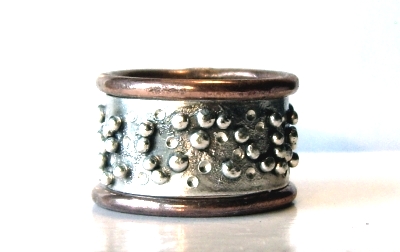
Granulation is a jewelry making technique used for decorating surfaces of gold and silver jewelry. Granules are small spheres of the same metal as the pieces of jewelry, and they are attached to (preferably) pure gold or silver.The process of attaching granules is so old that different sources ascribe it to different civilizations, such as Etruscan, Sumerian and Egyptian. It is believed that the first samples were found in Mesopotamia in the third millennium BC, and work of later dates has been found in Anatolia, Syria, Egypt, Cyprus, and Mycenaean Greece.
Sumerians were improving the technique in 2500 BC. Although granulation might have first been used by the Sumerians, it was the Etruscan who truly developed the technique' possibilities. The Etruscans really excelled in granulation. Not only was it used in the formation of patterns, but also to illustrate entire scenes.Nevertheless, when we mention granulation we think of Egypt. Why does this happen? There is no mystery in it. Egypt produced 80% of the world gold output in ancient times. They colonized Nubia for its gold and invented mining. By the 2nd half of the 3rd millennium BC Egypt was circulating gold rings of standard weights as money. The Middle Kingdom, 2040-1730BC, marks a high point in the art of the Egyptian jeweler. Chasing, repousse, inlaying in cloisonne and granulation were used.
This is one of the most ancient techniques in jewelery history, but it has been considered modern at different times. It is modern again. These days when hand made accessories are thought after granulated jewelery is considered the top of the line. It cannot be faked. It is always one-of-a-kind. It is contemporary in design and historical in technique, making it timeless and forever fashionable.
Natalia Khon
http://nataliakhon.com/classes.htm
Natalia Khon
http://nataliakhon.com/classes.htm
Labels:
Jewelry art history
Faberge and Reticlation
Saturday, May 22, 2010

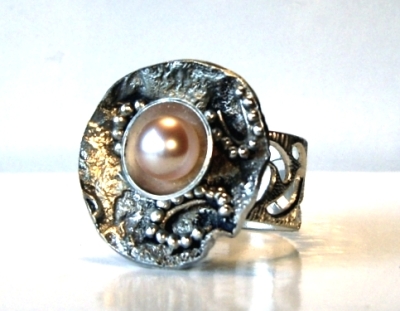
Reticulation is a three-dimensional texture on metal that can be described as dendritic or tree bark looking surface. It can be produced by heating up silver, gold or brass. The patterns can be somewhat controlled, though the technique itself is difficult to master. There are very few pieces of metal art that can be considered “fine”.
Different sources ascribe the technique to either Faberge or Scandinavian jewelers. Whether he invented or just developed it, he gave recognition to the reticulation starting from 1860. Most well known metal art pieces made in this technique are of Russian origin, mostly from the Faberge company.
Reticulation is known as “samorodok” which is a Russian name for it. You can find a translation to the word as “born by itself” (and that is true), but it is important to mention that the word refers to “nugget”. The wrinkled surface of metal looks like a nugget and this is why it has got that name.
A jeweler needs to have lots of experience to become very good at controlling the patterns. This is why it can be seen mostly in silver than gold. Though experienced jewelers can find a way to transfer a pretty pattern from silver to gold if they need to do so. Also, a special reticulation silver alloy gives better pronounced patterns than sterling silver.
Reticulation comes back in fashion from time to time. Nowadays, when organic shapes and forms are thought of, reticulation seems to be one of those surface embellishments that can give a modern look to a piece of jewelery.
Only a few years after school I tried this technique the first time, as it got me interested finally. I like the texture a lot as it really can change the look of an object and give it a visual dimension. A piece of jewelry made with it is truly eye-catching, especially if there are further embellishments taking place, such as stone setting and granulation. A course where I teach all the above has become one of my most favorite.
Natalia Khon
http://nataliakhon.com/class/class7.htm
Only a few years after school I tried this technique the first time, as it got me interested finally. I like the texture a lot as it really can change the look of an object and give it a visual dimension. A piece of jewelry made with it is truly eye-catching, especially if there are further embellishments taking place, such as stone setting and granulation. A course where I teach all the above has become one of my most favorite.
Natalia Khon
http://nataliakhon.com/class/class7.htm
Labels:
Jewelry art history
"Cut", "fire" and "luster" of a gem. What is it? (Part 2 of 5)
Beauty is a color, whether it is invigorating and warm color of a ruby or mysterious color of an emerald. A shape and a cut matters a lot too. They can show the beauty of a stone or kill it.
Only a professional gemologist can see if there is an interesting optical effect in the rough gem and choose the cut, that should be individual. Transparent stones mostly have faceted cuts, but if there is a "star" or a "cat's eye" effect then the stone must be cut as a cabochon.
How really beautiful is your stone? You need to know what to look at, so look at its lustre, brilliance and "fire".
Lustre is an optical effect produced by the light reflected from the surface of a mineral. Rays of light partially pass through a stone and they are partially reflected too. So, the brilliance depends on the internal nature of the stone on one hand and on the surface and the quality of its polish on another hand.
Look closely at your stone. How well is it polished? The surface should be smooth and shiny. If it is, you will be able to see the most brilliance and lustre that your stone can show.
Most transparent and translucent gems have brilliant (adamantine) and glass (vitreous) lustre. What lustre does your stone have? Does it have the same lustre as glass or is it much brighter, like a diamond?
Vitreous lustre is a characteristic of a quartz, sapphire or topaz.
Adamantine lustre is a characteristic of a diamond, zircon and demantoid (green garnet).
Resinous lustre is a lustre like that of a resin (examples: some garnets and amber).
Pearls and moonstone has pearly lustre.
Satin-spar has silky lustre.
If there is "fire" in a stone then it adds more beauty to it. Move your stone under the light. Do you see the sparkles of rainbow? Fire is especially important for the colourless stones. Usually the gems judged by the combination of lustre and "fire". A cut is chosen individually for each gem in order to enhance it. The most brilliant stones that have the best combination of both: diamonds, zircons, garnets almandine, rubies, sapphires, spinels and topazes.
Maria Roudakova
A jeweller from Switzerland
Labels:
jewellery facts,
Jewelry tips
Art Nouveau Jewelry
Monday, May 17, 2010
Art Nouveau is a style for jewellery, interior designs, visual art and architecture. It was in fashion for a short period of time from 1895 to 1905. It is a very feminine and sensuous style that features women with long hair, flowers, dragonflies, swans and other attractive creatures.The style was triggered by Czech artist Alphonse Mucha who was a visual artist. The most known jewelry artist of the Art Nouveau style was Rene J. Lalique.
When we studied Art History at our Jewelry Design course, the period of Art Nouveau was skipped by our teachers. I think they did it deliberately trying to save time and give us as much as possible. Art Nouveau style could not escape our attention... It never can :) Any art student who studies arts will come across this style… temporary fall in love with it and learn about it on their own.
That happened to us, of course…
We had a fun project called “A gift for a friend”. We wrote our names on pieces of paper. Whoever name you get then you make that person a gift. You need to interview them, but make somewhat a surprise.
Unbelievably enough I got my real friend’s name at that time. She told me that she loved Art Nouveau style and women with long hair in it especially. She thought about it for a few seconds… and told me I did not have to do that, as I was her friend and the project would be too complicated, and she did not want me to have any troubles. She will like anything I make, she has assured.
“No, no!” – I told her, - “If you like long haired women in Art Nouveau style, then this is what you will get!”
I took the challenge and really enjoyed making this piece for her. I could not wait to give it to her. When I did, I heard comments that other people wished I had their name on that piece of paper... It was one of those moments when you are happy giving something away. The emotions of that are unforgettable…
Labels:
Jewelry art history
Subscribe to:
Posts (Atom)