

 Posts


 |
| Epidote, 9.8 cm, from Knappenwand, Untersulzbachtal, Salzburg, Austria. Watzl Minerals specimen and photo. |
#naturesgems
Wednesday, June 15, 2016


#jewelleryfacts365 136/365 Copper fact
Turning to more modern times, the first observation of copper's role in the immune system was published in 1867 when it was reported that, during the cholera epidemics in Paris of 1832, 1849 and 1852, copper workers were immune to the disease. (source)
 |
| The Kennecott Utah Copper Mine, also known as the Bingham Canyon Copper Mine, is the largest and richest copper mine in history with over 100 years of open pit mining; it has produced more copper than any other mine in history. |

#jewelleryfacts365 135/365 Ruby fact
The most expensive ruby sold was a ‘pigeon’s blood red’ 8.62-carat cushion-cut ruby. Impressively, the ruby was an unheated Burmese stone that sold for $3,637,480 ($425,000 per carat). The gemstone was eventually purchased by Laurence Graff at Christie's, and set in a Bulgari rectangular-shaped diamond bombé mounted ring (2006, Geneva).
 |
| Photo courtesy of Christie's. |
Deer lake park, May, 2016
It was a long weekend and we needed to come with an idea where we could go. The Deer Lake park has a historical village. A great place to take the kids, right? So that was where we went to.
This barn is for an old tram:

And here is the tram itself:

Beautiful, isn't it?

This is an old church:

And a school:

I aimed my camera at this awesome man and he smiled for me. I took his picture and thanked him :)

I love this school room!

Just an old house where the kids sat at the table. Looks like my gramma's house as I remember it from my childhood.

A workshop:

A piece of the street:

A barber's shop (too bad there was no "barber" there!

I just liked these vases:

There was one really big house with awesome rooms in it to look at:

I would not mind this piece of furniture!

Lovely vintage room:

Another room I would mind to have in our house!

This is the house with all the rooms above:

Somebody has a fun job making all the little houses and trains!

This music machine is in the room with the vintage carousel. It works, of course!

This carousel is 104 y.o. I regret not taking a video of it. The horses are all different and many of them are encrusted with the glass gems.

I got to ride it too!

Then we went to the Deer lake. Water lilies were lovely!

...and so many of them!

I think this is a gallery of some kind... we did not get close to read what it was:

This is another gallery. We tried to go in, but it was closed:

Then we drove around and found the paddle boats for rent. Can you believe how close this house is to the water?

This is how far you can go:

Here they are:

We got out first and I took a picture of these ducklings while we were waiting for the kids:

The day was not over, so we stopped at a school with a great playground:


Then we stopped at another playground that was even more awesome! I took a picture of the roses while the kids were playing:

I wish I could join them, this looks like a lot of fun!

The little one liked this carousel (and did not like the one at the Deer Lake park):


#jewelleryfacts365 134/365 Ruby fact
In ancient India rubies were thought to attract health, wealth, and good fortune. Rubies were separated into classes based on their clarity and perfection. Lower class rubies were kept away from the higher classes as it was believed that the lower classes of stones could contaminate and ruin the nicer ones, just as one rotten fruit can spread to all the others. (source)
 |
| "Rubies from Jegdalek" Photo: Vincent Pardieu, GIA Laboratory Bangkok, 2011 |
#jewelleryfacts365 133/365 Garnet fact
Sunday, June 12, 2016
Garnet species are found in many colors including red, orange, yellow, green, purple, brown, blue, black, pink, and colorless, with reddish shades most common.
 |
| Reticulated ring with a garnet cabochon |
#jewelleryfacts365 132/365 Ancient Egyptian jewellery fact
Saturday, June 11, 2016
The Egyptian use of turquoise stretches back as far as the First Dynasty and possibly earlier; however, probably the most well-known pieces incorporating the gem are those recovered from Tutankhamun's tomb, most notably the Pharaoh's iconic burial mask which was liberally inlaid with the stone.
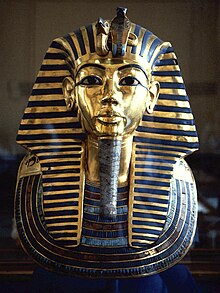 |
| The iconic gold burial mask of Tutankhamun, inlaid with turquoise, lapis lazuli, carnelian and coloured glass. |

Subscribe to:
Posts (Atom)